From Agencies’ reports
NEW YORK/CHICAGO: Congress leader and Leader of the Opposition in the Lok Sabha Rahul Gandhi’s November 16–19 visit to the United States has triggered a fresh political confrontation between the Congress and the Bharatiya Janata Party (BJP), following his critical remarks about India's economy, democratic institutions, unemployment and the Narendra Modi government.
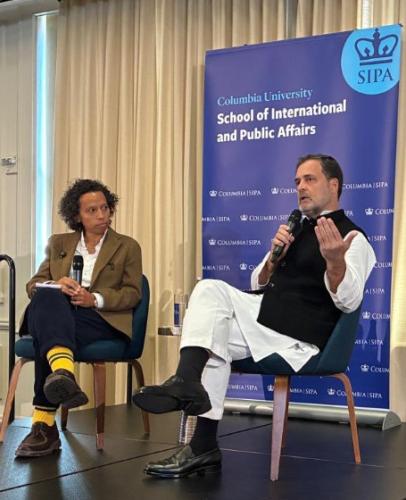
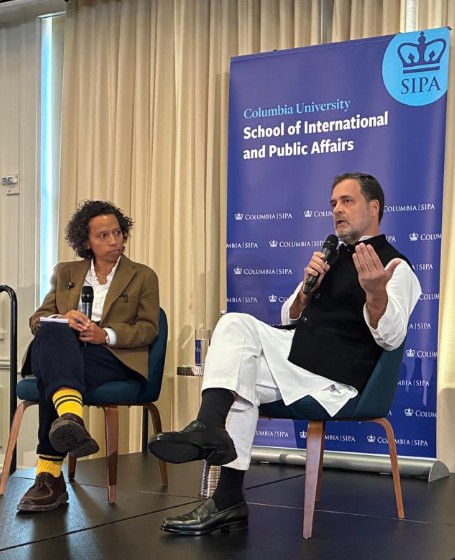
Gandhi addressed students and faculty members at Columbia University in New York on November 17 and participated in an interaction at the University of Chicago on November 18. Although the engagements were planned around student movements, geopolitics and international affairs, his comments on India's domestic political and economic situation became the principal focus of controversy.
At Columbia University, Gandhi described India as being on the verge of an "economic disaster," citing widespread unemployment, weaknesses in the education system and what he characterized as the failure of government initiatives such as Make in India and Start-up India to generate sufficient employment.
He argued that small and medium-sized businesses, agriculture and manufacturing should form the backbone of India's job-creation strategy. He also questioned the concentration of economic opportunities among a small number of large corporate groups.
Gandhi further raised allegations of electoral malpractice, questioning the credibility of India's electoral processes and calling for the restoration of confidence in the electoral system. These were his political allegations, rather than findings established by an independent investigation.
At the University of Chicago, Gandhi also criticized the Modi government's foreign policy, arguing that India had become a "side player" in international affairs. He expressed surprise that Pakistan was involved in facilitating discussions between the United States and Iran while India appeared to have a limited role. He questioned the government's reliance on personal relationships between Prime Minister Modi and other world leaders, arguing that India should exercise greater diplomatic influence.
Another significant controversy emerged from his comments on Indian democracy. Gandhi said that Indian democracy was "sacred" and that he would need substantial evidence before declaring that something was wrong with the democratic system. He also alleged irregularities in the 2014 and 2024 elections and claimed that the Congress was receiving information from within the Election Commission.
Interestingly, a controversy developed over the word "sacred." BJP spokesperson Pradeep Bhandari circulated a video and claimed Gandhi had described Indian democracy as "sick." However, a subsequent examination of the video by NDTV reported that Gandhi had actually said "sacred," not "sick." The distinction became another point of political contention.
BJP and government leaders hit back
The BJP launched a strong response to Gandhi's remarks, accusing him of presenting a negative picture of India while speaking on American soil.
Union Parliamentary Affairs Minister Kiren Rijiju questioned Gandhi's responsibility as Leader of the Opposition, saying that he should exercise caution while making statements about India abroad. Rijiju also rejected his economic assessment, pointing to international financial institutions' recognition of India as one of the world's fastest-growing major economies.
BJP spokesperson Pradeep Bhandari accused Gandhi of pursuing what he described as anti-India propaganda. Other BJP leaders argued that criticism of the government should not be presented in a manner that could undermine confidence in India's democratic institutions and international standing.
The BJP also challenged Gandhi's allegations about electoral irregularities, questioning why opposition parties continued to contest elections and organize protests if democratic freedoms had been eliminated.
Congress defends Rahul Gandhi
The Congress leadership defended Gandhi's right to raise questions about India's political and economic conditions before international audiences.
Congress leader Pawan Khera argued that the government appeared more concerned about Gandhi discussing the economy internationally than addressing the problems he had raised.
Earlier, Indian Overseas Congress chairman Sam Pitroda had also defended Gandhi's overseas engagements, maintaining that issues discussed in India could legitimately be discussed abroad. He argued that information and political discussions could not be confined within national boundaries.
Congress leader Madhu Goud Yaskhi separately alleged that Indian diplomatic missions had been instructed by the Ministry of External Affairs not to cooperate with Gandhi during his overseas visits. This remains an allegation by a Congress leader; an independently verified government confirmation was not available in the reports reviewed.
A larger question about India's international image
Gandhi's American visit has once again brought into focus a recurring debate in Indian politics: where should the line be drawn between a political opposition leader's responsibility to question the government and the country's interest in maintaining its international reputation?
The Congress maintains that democratic accountability requires opposition leaders to raise concerns about unemployment, electoral transparency, economic inequality and institutional independence, irrespective of where they speak. The BJP argues that such criticism, particularly when delivered overseas, can damage India's image and provide ammunition to those opposed to the country.
For the large Indian-American community, the controversy carries an additional dimension. Many Indian Americans follow political developments in India closely while also taking pride in India's economic growth, democratic traditions and increasing international engagement.
Rahul Gandhi's New York and Chicago engagements have therefore become more than university discussions. They have reopened a debate about India's democracy, economic direction, foreign policy and the responsibilities of political leadership in an increasingly interconnected world.
The central question remains whether India's political disagreements can be debated internationally without turning every criticism of the government into a controversy over national loyalty.
Sources: The Indian Express, Press Trust of India, NDTV, The New Indian Express and India Today, November 18–19, 2026.