India Tribune Newsdesk
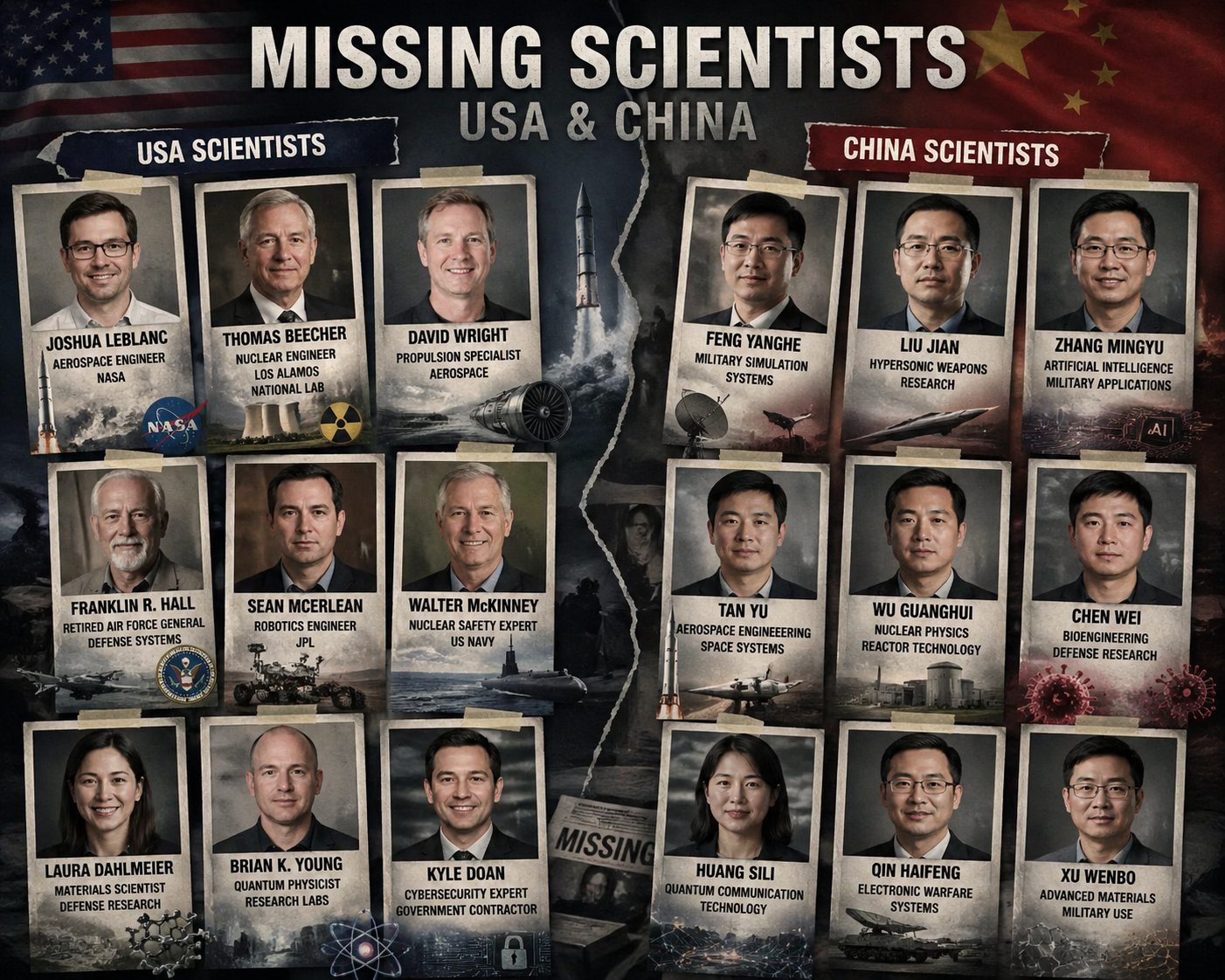
The recent wave of stories about mysteriously missing or dead scientists in the United States and China has created a powerful mix of fear, speculation, and geopolitical anxiety. Reports published in April 2026 claim that around 11 American scientists and researchers tied to aerospace, nuclear, or defense-related work have died or disappeared in recent years, while at least nine Chinese scientists in similarly sensitive sectors have also died unexpectedly. The dramatic framing of these cases has led some commentators to ask whether there is a hidden campaign targeting scientific talent in the world’s two biggest powers.
In the United States, several names have circulated repeatedly in media coverage. These include personnel linked to NASA, Los Alamos National Laboratory, Jet Propulsion Laboratory, and retired military officials with experience in classified programs. The FBI reportedly opened an inquiry into whether any connections exist among a cluster of deaths and disappearances dating back to 2022. Congressional figures also requested briefings, arguing that even the possibility of a coordinated threat to scientists should be examined. However, officials and outside experts quoted in coverage have also stressed that no confirmed evidence has emerged proving these cases are linked.
The mystery has been fueled by the unusual details in some cases. A retired Air Force general reportedly vanished in 2026. A NASA-linked engineer died after a car crash involving a burned vehicle. Other individuals were said to have died suddenly, with limited public explanations. Because several worked in advanced technology fields such as propulsion, nuclear systems, or aerospace engineering, online speculation quickly moved beyond ordinary explanations and into theories involving espionage, sabotage, or secret programs.
China has seen a parallel set of reports. Foreign media summaries say at least nine Chinese scientists connected to military artificial intelligence, hypersonic weapons, space research, and defense technologies have died in recent years. One frequently cited case is Feng Yanghe, a professor linked to military simulations, whose death in a traffic accident drew attention because of his strategic research role and the ceremonial nature of his burial. Other reported deaths involved illness, accidents, or unspecified causes, though reliable public information remains limited.
The comparison between the two countries is what gives the story its emotional force. If only one nation were experiencing unexplained scientist deaths, observers might focus on domestic factors. But when both Washington and Beijing appear to face similar losses among elite technical personnel, some people imagine a silent struggle beneath normal diplomacy. They wonder whether rival intelligence services, criminal networks, or internal political purges are removing people with valuable knowledge. These ideas spread quickly because they fit the broader narrative of U.S.-China technological rivalry over semiconductors, AI, quantum systems, and military modernization.
Yet there is another, more cautious explanation: coincidence amplified by modern media. In any large country, thousands of scientists, engineers, and defense workers are employed across many institutions. Over a span of several years, some will die unexpectedly, suffer mental health crises, experience accidents, or go missing for personal reasons. Once journalists or social media users gather scattered incidents into one list, the result can look like a pattern even when no operational link exists. This phenomenon—seeing meaningful connections in random clusters—is common in public reactions to uncertainty.
Several mainstream reports have emphasized exactly that point. Families of some victims and analysts interviewed by the press said many cases have plausible individual explanations, including suicide, medical emergencies, accidents, or unrelated criminal acts. Experts also note that people working in classified fields naturally attract more attention when tragedy strikes, because secrecy creates informational gaps that conspiracy theories can fill.
Still, governments cannot simply dismiss such concerns. Scientists working in nuclear, aerospace, cyber, or military research are strategic assets. If even one hostile actor were targeting them for recruitment, intimidation, or elimination, the national security implications would be serious. That is why investigations matter even when the most likely answer may be mundane. Responsible inquiry can separate rumor from fact, reassure the public, and identify any real vulnerabilities in protecting high-value personnel.
The deeper lesson may be that science itself has become part of great-power competition. Researchers are no longer viewed only as academics in laboratories. They are seen as contributors to weapons systems, industrial policy, AI leadership, and national prestige. As a result, the disappearance or death of a scientist can trigger headlines once reserved for diplomats or generals.
For now, the “mystery” remains unresolved largely because there may be no single mystery at all. The American and Chinese cases may represent a mixture of unrelated tragedies, bureaucratic secrecy, sensational reporting, and legitimate security concerns. Until investigators release hard evidence showing a coordinated campaign, the most balanced conclusion is that these incidents deserve scrutiny—but not panic. In an era shaped by rivalry and distrust, uncertainty itself often becomes the biggest story.