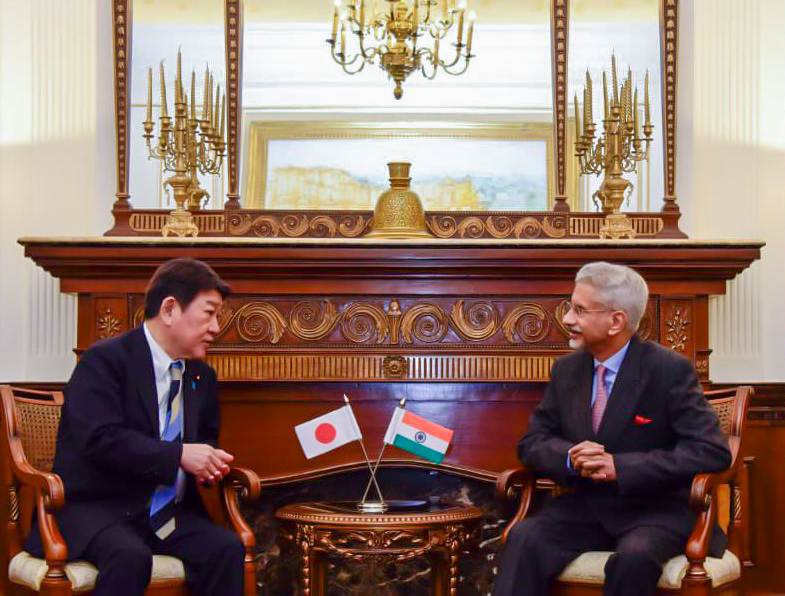
New Delhi/Tokyo, Jan 19 (IANS) The recent visit of Japanese Foreign Minister Toshimitsu Motegi to India marked an “execution phase” in bilateral ties, moving from visionary agreements to tangible outcomes. Through diversified partnerships between the two nations, India enhances its strategic autonomy, reducing dependence on any singular power while promoting free and open Indo-Pacific principles to deter coercion, a report said on Monday.
“Japan’s Foreign Minister Toshimitsu Motegi’s visit to India from January 15 to 17, 2026, underscores the deepening strategic partnership between the two nations amid evolving Indo-Pacific dynamics. This three-day engagement, featuring high-level dialogues and symbolic gestures, signals India’s intent to fortify alliances against regional assertiveness, particularly from China. From New Delhi’s vantage, the visit exemplifies a pragmatic pivot toward resilient economic and security architectures,” a report in India Narrative detailed.
“Foreign Minister Motegi engaged in substantive bilateral interactions, commencing with the 18th India-Japan Foreign Ministerial Strategic Dialogue alongside External Affairs Minister S. Jaishankar on January 16. Discussions reviewed advancements since Prime Minister Narendra Modi’s August 2025 visit to Japan, which birthed the ‘Japan-India Joint Vision for the Next Decade,’ encompassing security, economic resilience, innovation, and cultural ties,” it added.
Among the main outcomes of the 18th India-Japan Foreign Ministerial Strategic Dialogue were the launch of an AI dialogue mechanism and a Joint Working Group on critical minerals, with emphasis on rare earth elements and supply chain fortification. Motegi also paid a courtesy call on Prime Minister Narendra Modi during the recent visit, where the two leaders exchanged views on economic security, artificial intelligence, investments, and people-to-people connectivity.
According to the report, Motegi’s visit reinforces countermeasures to China’s maritime assertiveness in the Indian Ocean and its control over the supply chains.
“The Quad framework — comprising India, Japan, the United States, and Australia — emerges as pivotal, promoting a Free and Open Indo-Pacific (FOIP) predicated on rule-of-law principles. Motegi’s emphasis on economic security dovetails with India’s Atmanirbhar Bharat initiative, mitigating vulnerabilities in semiconductors, batteries, and critical minerals via Japanese technology transfers, such as the Unified Complex Radio Antenna (UNICORN) for defence interoperability," it mentioned.
In the broader geopolitical context, the report said, Motegi’s India trip —part of his inaugural 2026 overseas tour following stops in Israel, Qatar, and the Philippines—underscored Japan’s proactive diplomacy under Prime Minister Sanae Takaichi.
“For India, it signals Tokyo’s reliability as a counterweight to Beijing’s assertiveness, including South China Sea militarisation and Indian Ocean forays. The partnership transcends bilateralism, embedding within G20, G4, and UN platforms to advocate reformed global governance,” it noted.