By J V Lakshmana Rao and Prasad Peketi
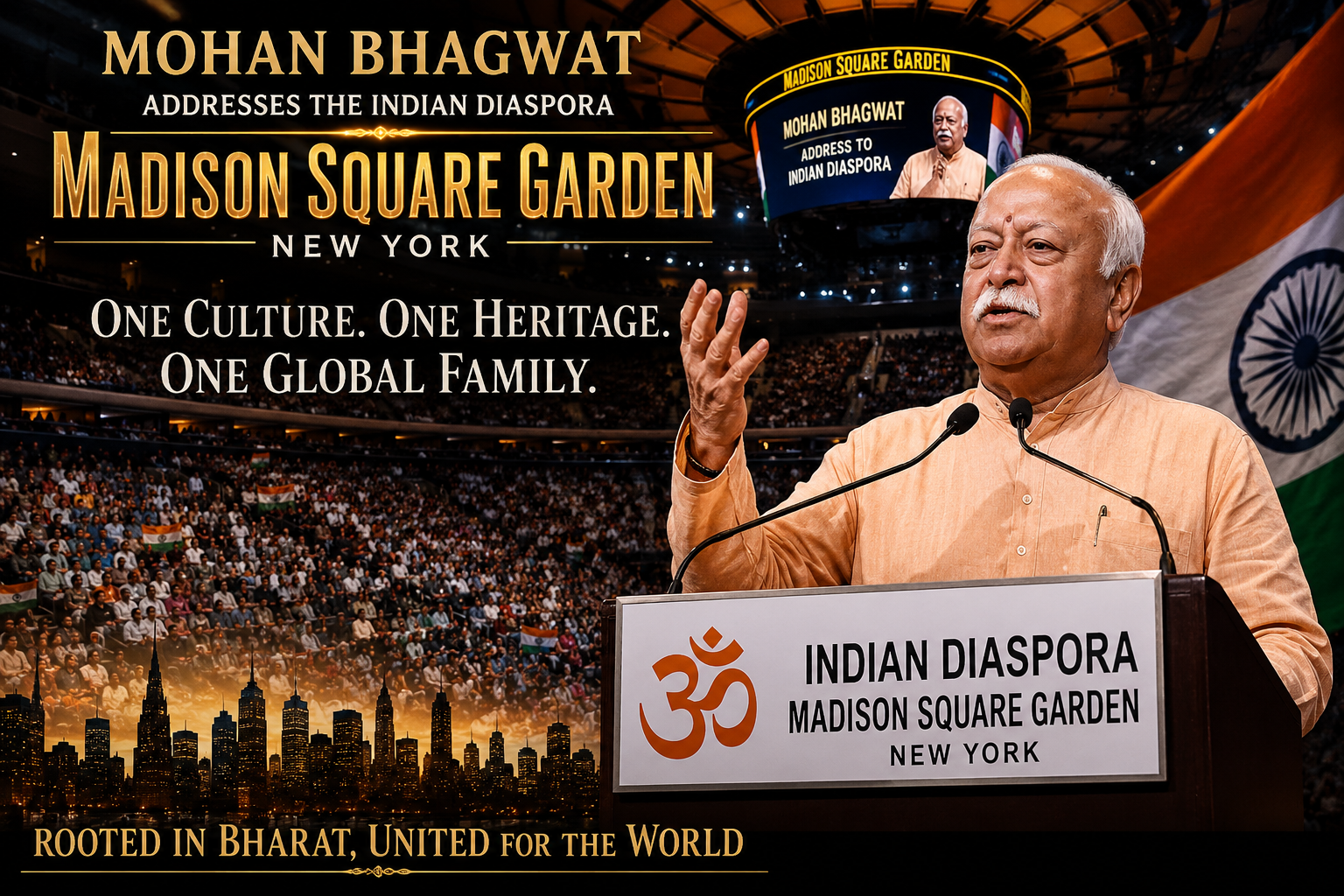
One hundred years ago, the Rashtriya Swayamsevak Sangh (RSS) began its work in a modest locality of Nagpur. Last week, its Sarsanghchalak, Dr. Mohan Bhagwat, stood before several thousand people at Madison Square Garden in New York.
The distance between these two moments is not merely geographical. It is civilizational, ideological and, above all, narrative. Coming in the Sangh’s centenary year, the visit did more than address the Indian American community. It placed Hindu thought, and the organization that claims to speak from within that tradition, on a stage that America itself treats as historic.
Six aspects of the visit deserve particular attention.
First, the access to a major public platform: Madison Square Garden is not just another hall. It is a venue associated with American political conventions, global sporting events and landmark public addresses. For an organization long described by its critics as inward-looking and confined to the Indian street, the very fact that the Sarsanghchalak addressed a large gathering there is significant. The journey from a small shakha in Nagpur to one of the most recognized arenas in the United States cannot be dismissed as optics alone. It suggests that the Sangh has secured a public hearing beyond India.
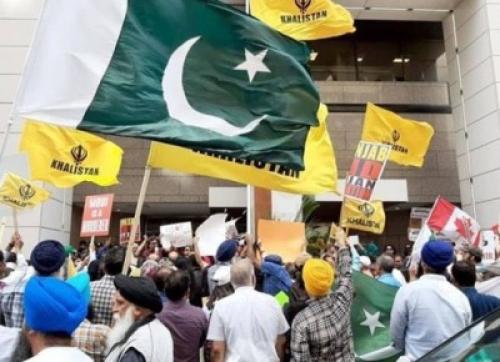
Second, the internationalising of an Indian ideological debate. The arguments that dominate Indian public life over Hindu identity, nationhood and civilisational continuity were, in this form, carried onto American soil. Civil rights groups, sections of New York’s political class, and even a US federal commission opposed the program and questioned the RSS’s record. But there was another response too. A large section of the Hindu community in America did not step back. They filled the venue, held their ground and insisted that their understanding of Hindu dharma and India also deserved to be heard. In doing so, they took a debate usually fought within India and placed it before a global audience.
Third, the attention of mainstream media. Associated Press, Reuters and the Wall Street Journal all took note. For years, coverage of India in much of the Western press has revolved around elections, personalities and a familiar set of controversies. This visit compelled a somewhat different conversation—about Hindu dharma, Hindu philosophy and the global presence of Hindu organisations. Once such a subject enters the pages of wire services and a paper of record, it is no longer only an internal Indian matter. That change in frame is itself important.
Fourth, direct representation of the Hindu community. For too long, the story of Hindus in America has often been told by organizations and commentators who do not necessarily share their civilisational self-understanding. This time, the prominent body working among Hindus, and claiming to speak from within that tradition, placed its own view before an American audience. The larger point is not that every Hindu must accept that view. It is that a large, organized Hindu voice was no longer content to remain merely the subject of other people’s descriptions. In public life, representation matters.
Fifth, a mature ethics of mathrubhumi and karmabhoomi: This was perhaps one of the most important messages of the visit, and it should not be read only as an advice to Indians living abroad. Dr. Bhagwat told the gathering that America was their karmabhoomi—the land where they live, work and earn—and that their first duty was to be true to it. Bharat, he said, remains the janmabhoomior mathrubhumi. Contribution to the motherland is welcome, but not compulsory. What the motherland expects most is that her children live by the values she has given them, especially the value of oneness.
The principle is far larger than the NRI question. It applies with equal force inside India. A young man from Bihar working in Mumbai, a Tamil family settled in Delhi, a Gujarati trader in Hyderabad, or a Kashmiri student making her life in Bengaluru, all live in some relationship between mathrubhumi and karmabhoomi. Love for the soil of one’s birth need not become suspicion of the soil that sustains one. The land of work deserves loyalty, language, civic sense and belonging. The land of origin deserves memory, values and gratitude. When these two are placed in opposition, society becomes restless. When they are held together, both the migrant and the host society are strengthened. In that sense, the New York message was not a special sermon for the diaspora. It was a civilizational rule of life for a people who have always moved—across oceans and across Indian states.
Sixth, the projection of a universal message: In his address, Dr. Bhagwat returned to the old Upanishadic line: Ekam sat vipra bahudha vadanti—truth is one, the wise speak of it in many ways. He invoked Swami Vivekananda and argued that Hindu thought does not merely tolerate other paths; it respects them. Dharma, he said, is not sectarian worship but a principle of balance. Bharat’s destiny, in this telling, is to show the world that unity and diversity can live together—not through slogans, but through lived practice. Whether one accepts the Sangh’s claim to embody that message is a separate debate. What cannot be denied is that this was the language chosen for the American stage: inclusive, civilizational and addressed to humanity rather than to a vote bank.
The RSS of 1925 was a local experiment in character-building. The RSS in its hundredth year is attempting to speak, through its chief, to a diaspora living in the world’s most powerful country and to a media system that shapes global opinion. The protests outside Madison Square Garden were as much a part of that story as the applause inside. They showed that the visit had consequences and that the conversation around the Sangh is no longer confined to India alone.
This column is not a verdict on the Sangh’s entire history. It is an assessment of one journey. From Nagpur to Madison Square Garden is a long road. The fact that it has been travelled in the centenary year, and that the world was compelled to take notice, is the real news. The deeper point, however, may be quieter: a people who remember their mathrubhumi and honor their karmabhoomi—whether in New York or in another Indian state—are better prepared to live with difference without losing themselves.