By Prashant Shah
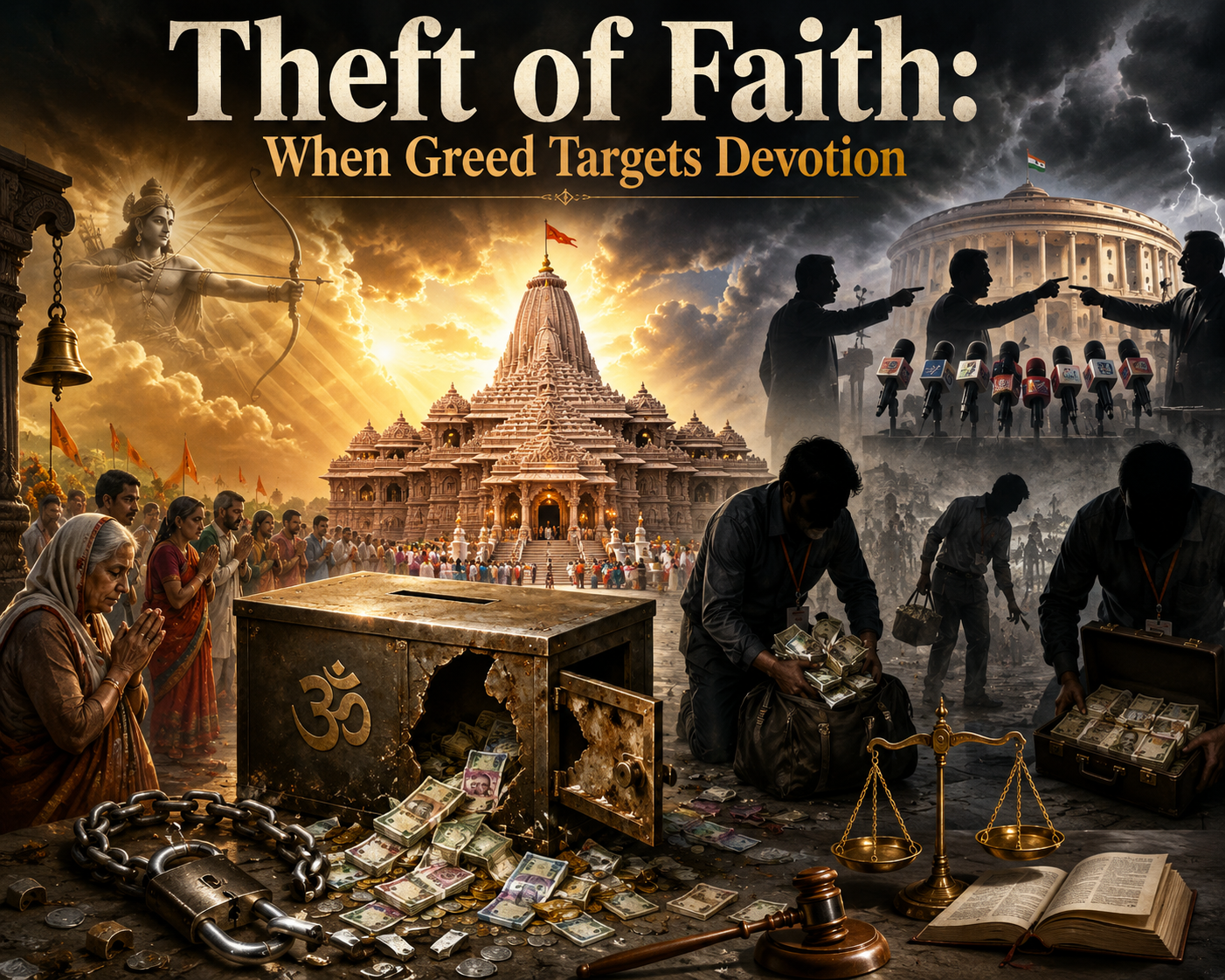
The alleged embezzlement of devotees' donations at the Ram Temple in Ayodhya has undoubtedly shocked millions of Hindus across India and around the world. Every rupee placed in the donation box is not merely a financial contribution—it is an offering of faith, devotion, and spiritual surrender before Lord Ram. If anyone entrusted with protecting those sacred offerings has indeed betrayed that trust, the crime is far greater than ordinary theft. It is an assault on the confidence of millions of devotees who donated with pure hearts. Such an offense deserves a transparent investigation and the strictest punishment permissible under law, regardless of the position, influence, or political connections of those involved.
Yet, while the alleged crime deserves uncompromising legal action, an equally disturbing development has emerged. Even before the investigation reaches its conclusion, political parties have rushed to convert the incident into an election issue, launching accusations against the BJP, the RSS, and the Shri Ram Janmabhoomi Teerth Kshetra Trust. Instead of allowing law enforcement agencies to establish the facts, political leaders appear more interested in extracting electoral mileage from a deeply sensitive religious matter.
Senior Congress leader Digvijaya Singh has announced what he describes as a "non-political" padyatra from Ujjain's Mahakal Temple to Ayodhya on October 2, demanding transparency in the donations made for the Ram Temple. He has also declared that he will approach the court seeking accountability for his own donation. While every citizen has the democratic right to demand transparency, calling such a politically charged march "non-political" stretches credibility. When senior politicians undertake highly publicized yatras over an issue already under investigation, separating politics from symbolism becomes virtually impossible.
Congress leader Priyanka Gandhi Vadra described the alleged theft as "tragic" and "shameful," insisting that donations offered by devotees must be protected and demanding a thorough investigation. Samajwadi Party leader Akhilesh Yadav called the alleged embezzlement "condemnable," asserting that "people's faith has been played with." He questioned how the Uttar Pradesh government could have remained unaware of the alleged irregularities and went further by alleging that "for the BJP, money is the only religion."
Former Delhi Chief Minister Arvind Kejriwal described the alleged fraud as merely "the tip of the iceberg," suggesting that influential people were being protected. He questioned the credibility of the investigation, demanded strict punishment for everyone involved, urged devotees to raise their voices, and even called for a social boycott of those accused.
Shiv Sena (UBT) chief Uddhav Thackeray also entered the debate, accusing the BJP of betraying Hindus despite projecting itself as the guardian of Hindutva. Meanwhile, AIMIM leader Asaduddin Owaisi argued that had a Muslim been accused of stealing temple donations, there would have been demands for police encounters and bulldozer action against the accused's property, raising questions about what he described as unequal standards of justice.
Every political leader has the constitutional right to express concern and demand accountability. Indeed, transparency in managing public donations to religious institutions is essential. However, there is a crucial distinction between demanding justice and exploiting public outrage to settle political scores. Allegations are not convictions. Investigations are not verdicts. A responsible democracy must allow due process to establish the truth before assigning collective blame.
One must also remember the extraordinary historical context surrounding the Ram Temple. For centuries, invading rulers and plundering empires looted countless Hindu temples, destroyed sacred structures, and carried away immeasurable wealth. Their objective was not simply economic gain but also the humiliation of a civilization and the weakening of its spiritual foundations. Yet history records a remarkable reality. Neither invasions, nor destruction, nor repeated attacks on temples succeeded in erasing the faith of Hindu society. Temples were rebuilt. Pilgrimages resumed. Devotion endured. Faith proved stronger than force.
That enduring resilience offers an important lesson today. If centuries of invasions, destruction, and systematic temple lootings could not extinguish Hindu faith, it is unrealistic to believe that the alleged criminal acts of a handful of dishonest individuals can weaken the devotion of millions. Criminals may steal money, but they cannot steal faith. They may betray an institution, but they cannot destroy the spiritual bond between Lord Ram and His devotees.
This is precisely why political attempts to portray the incident as evidence of the collapse of an entire movement or to assign collective guilt to political organizations before the investigation concludes are both irresponsible and unfair. Individual wrongdoing, if established, must result in individual accountability. It should not become a weapon for political polarization or electoral propaganda.
The Ram Temple is not the property of any political party. It belongs to the faith and emotions of millions of devotees across India and the global Hindu community. The temple transcends governments, political ideologies, and electoral cycles. Political parties will rise and fall. Governments will change. Elections will come and go. But Lord Ram will continue to inspire generations with ideals of truth, righteousness, sacrifice, and justice.
This is also the moment for the Shri Ram Janmabhoomi Teerth Kshetra Trust to demonstrate complete transparency. Every allegation should be independently examined. Financial systems, auditing mechanisms, and donation management procedures should be reviewed and strengthened wherever necessary. The Trust has both a legal and moral responsibility to reassure devotees that every offering made in faith is protected with the highest standards of accountability. Transparency will strengthen public confidence far more effectively than political rhetoric ever can.
Equally, investigating agencies must function without fear or favor. If the allegations are substantiated, those responsible must face swift prosecution and exemplary punishment. There can be no protection for anyone who misuses religious donations. The sanctity of the temple demands nothing less. Accountability should be absolute, regardless of rank, influence, or affiliation.
India's democracy is healthiest when justice is guided by evidence rather than political expediency. The nation has witnessed far too many instances where criminal investigations become vehicles for partisan confrontation instead of objective truth. Ayodhya deserves better. Millions of devotees deserve better.
The real issue before the country is not whether one political party can score points over another. The real issue is whether sacred public trust can be preserved through transparency, integrity, and the rule of law. That objective should unite every political party rather than divide them.